For years, installing solar panels in the UK has generally meant having a professionally designed rooftop system connected into your home’s electrical installation.
But that has just changed.
From 27 August 2026, plug-in solar panels became legal to buy and use across Great Britain, following changes introduced by the UK Government. The technology is designed to make small-scale solar generation cheaper and more accessible, particularly for households that may not be able to install a conventional rooftop solar PV system.
But while the words “plug-in solar” make the technology sound as straightforward as plugging in a television or kettle, there are some important considerations before you rush out and buy one. At Carter Renewables, we’re taking a closer look at what’s changed, how plug-in solar works and whether it could be right for your home.
What exactly is plug-in solar?
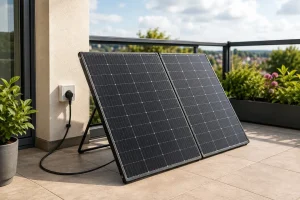
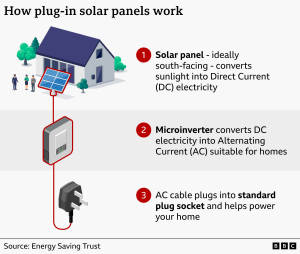
Plug-in solar – sometimes called balcony solar or plug-and-play solar – is a much smaller alternative to a traditional rooftop solar PV installation.A compliant system consists of at least one solar PV module, a microinverter, mounting equipment and a manufacturer-supplied cable and plug.
Instead of being permanently wired into a dedicated solar circuit, the system is designed to connect to a suitable standard UK mains socket.The new UK specification limits a plug-in solar system to 800VA, and only one plug-in solar product per household is permitted under the interim specification.
Why has the UK Government changed the rules?
Plug-in solar has already become popular in parts of Europe, particularly Germany. The UK Government wants to make small-scale renewable generation accessible to more households, including people who may not have a suitable roof or the budget for a conventional solar PV installation.
Government figures suggest that an 800W plug-in system could provide up to 20% of an average home’s electricity consumption and save a household up to £110 per year, although actual generation and savings will depend heavily on where the panels are positioned and when the household uses electricity.
Where could you put plug-in solar panels?
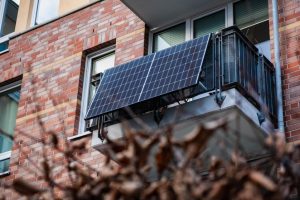
That’s potentially one of the biggest advantages of the technology. Rather than requiring a full rooftop installation, plug-in panels could potentially be positioned in suitable outdoor spaces or on some balconies.
That could make them attractive to people living in:
- flats and apartments
- rented properties
- homes with unsuitable roofs
- properties where a full solar installation isn’t financially viable.
However, “plug-in” doesn’t mean you can simply position panels anywhere. Depending on your property, you may still need permission from your landlord, building owner or freeholder, while planning permission or listed-building consent could also be relevant.
But can you really just plug them in?
This is where homeowners need to be careful. The Institution of Engineering and Technology (IET) has welcomed the potential of plug-in solar but is advising consumers to have their home’s electrical installation assessed by a competent electrician before purchasing or connecting a system.
One particular consideration is the home’s Residual Current Device (RCD) protection. Different types of RCD exist, and some older installations may not necessarily be suitable for plug-in solar. The IET’s research found that while 39% of UK adults thought they would be confident in checking whether their installation was suitable, only 25% knew what type of RCD was installed in their home.
Don’t assume every product you find online is suitable
The change in legislation doesn’t mean that any solar panel with a three-pin plug attached to it is now safe or legal to use. Products need to comply with the relevant UK requirements, and the Government’s interim specification includes requirements covering the microinverter, plug, mounting system, electrical protection and other aspects of the equipment.
If your chosen location is several metres away from the nearest socket, your first instinct might be to reach for an extension lead, but don’t assume that’s acceptable. The IET says plug-in solar units should typically be connected directly to a suitable socket outlet, and warns that using extension leads or adaptors where they aren’t intended could introduce additional safety risks.
Plug-in solar vs conventional rooftop solar
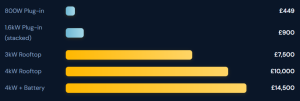
A conventional solar system can utilise a much larger roof area and therefore potentially generate considerably more electricity. It can also be designed alongside technologies such as home battery storage, EV charging and energy-management systems, allowing households to make much greater use of the energy they generate. However, it also comes with a much higher price-tag, with a traditional install also including costs such as scaffolding, certified installation labour, an inverter and MCS certification.
Plug-in solar is therefore better viewed as another, more affordable, option within the renewable-energy market rather than a replacement for conventional solar PV. For someone living in a flat with a sunny balcony, for example, an 800W system could provide access to solar generation where previously there may have been very few options.
Thinking about plug-in solar? Check your electrics first
If you’re considering buying a plug-in solar system, Carter Renewables can assess your existing electrical installation and advise whether it is suitable before you connect one.
And if you’re considering solar because you want to make a more significant reduction to your household’s grid electricity consumption, it may also be worth comparing plug-in solar against a professionally designed rooftop solar PV and battery storage system before making your decision. With nearly 172,000 solar installations already fitted across the UK during 2026, interest in generating clean electricity at home is clearly continuing to grow.
Thinking about solar? Speak to Carter Renewables about plug-in solar, rooftop solar PV, battery storage and the options available for your property by dropping us a message via our Contact Form, or calling us on 0118 967 7033.